

QUICK ANSWER
A standard T-120 VHS tape holds about 2 hours at SP (Standard Play), 4 hours at LP (Long Play) and 6 hours at EP or SLP (Extended Play). Longer tapes hold more, up to about 9 hours on a T-180 at EP. Slower speeds fit more video on the same tape but record a softer, noisier picture that is harder to play back cleanly today.
If you've ever pulled an old tape off the shelf and wondered how a "2-hour" cassette ended up holding an entire week of soap operas, the answer is the speed setting on the VCR. Most machines let you pick how fast the tape moved while it recorded. Slower meant more time on the same tape, and that trade-off still matters when you go to watch or digitize those tapes now.
Here's how it works, in plain terms.
How many hours does a VHS tape hold?
It depends on two things: the length of the tape, and the speed it was recorded at.
The U.S. National Archives lists the general running times for the three VHS speeds on a standard T-120 tape:
| Recording speed | Also called | Running time on a T-120 |
|---|---|---|
| SP | Standard Play | About 2 hours |
| LP | Long Play | About 4 hours |
| EP | Extended Play, or SLP (Super Long Play) | About 6 hours |
So the same blank tape could hold one movie, two movies, or a full evening of TV, depending on which button got pushed.
What the T-120 on the label means
The number after the "T" is the tape's length in minutes at the standard speed. A T-120 runs 120 minutes at SP. A T-60 is half that, a T-160 is longer, and so on.
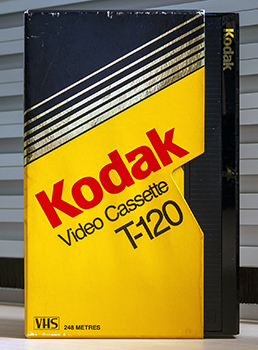
To figure out the most a tape could hold, multiply its SP time by three for EP. Sony's manual for one of its later VCRs, the SLV-469, lists a maximum of 9 hours in EP mode on a T-180 tape. That lines up: 3 hours at SP, times three.
| Tape | At SP | At LP | At EP |
|---|---|---|---|
| T-60 | 1 hour | 2 hours | 3 hours |
| T-120 | 2 hours | 4 hours | 6 hours |
| T-160 | 2 hours 40 minutes | 5 hours 20 minutes | 8 hours |
| T-180 | 3 hours | 6 hours | 9 hours |
These are approximate times.
Camcorder tapes are shorter
The compact VHS-C tapes that went in many family camcorders hold far less. A common JVC TC-30, for example, is rated for 30 minutes at SP or 90 minutes at EP.
Why slower speeds look worse
Recording at a slower speed packs the same picture into less tape. Sony's specifications show the difference clearly: the tape moves at about 33 millimeters per second in SP, but only about 11 millimeters per second in EP. That's one third of the tape for the same amount of video.

Less tape means less room for picture detail. EP recordings tend to look softer and grainier than SP, even when they were brand new. They're also more sensitive to tracking problems and tape wear, so an EP tape that's been sitting in a closet for thirty years usually has less margin for error than an SP tape of the same age.
One more wrinkle: not every VCR could record at every speed. That same Sony manual lists LP as "playback only," meaning the machine could play LP tapes but couldn't record them.
How to tell what speed your tapes were recorded at
You don't need special equipment to make a good guess:
- Check the length of what's on it. If a T-120 tape has a full 6-hour TV marathon on it, it was recorded at EP. If it holds one 2-hour movie, it's probably SP.
- Look at the label. People often wrote "SP" or "EP" on the label, or a list of shows that's clearly too long for 2 hours.
- Watch the display on a VCR. Many VCRs show the speed on the front panel or the TV screen during playback.
- Think about what's on it. Long TV recordings are the most likely to be EP, since fitting more on one tape was the whole point of the slow speed.
A single tape can also have more than one speed on it if someone recorded at SP and later added more at EP. The VCR switches automatically during playback.
Why the speed matters when you digitize
Every minute on a tape plays back in real time, so an EP tape holds three times as much to watch as the same tape at SP. That's worth knowing for two reasons:
- There may be more on your tapes than you think. A tape labeled "Christmas 1991" might have a birthday party, a school play and an hour of TV recorded after it. People often find footage they forgot existed.
- EP tapes are the fragile ones. Because they were recorded with less tape per second, they have the least room for wear. If you have EP tapes with family footage, those are good ones to digitize sooner rather than later.
Tape age matters too. If you're curious how long tapes last in storage, I wrote about it in How Long Do VHS Tapes Really Last?
Getting your tapes transferred
At Rewind I transfer VHS and VHS-C tapes to digital files, whatever speed they were recorded at, and every tape is played in real time so nothing gets skipped. Pricing is per tape and listed on the pricing page. If you're not sure what you have, or a few of your tapes are long EP recordings and you have questions, just ask me.
Common questions
What does T-120 mean on a VHS tape?
It's the tape's length in minutes at the standard SP speed. A T-120 runs 120 minutes, or 2 hours, at SP. Recorded at LP it holds about 4 hours, and at EP about 6.
Is SLP the same as EP?
Yes. Different brands used different names for the slowest VHS speed. SLP (Super Long Play) and EP (Extended Play) are the same setting, and both fit about 6 hours on a T-120.
How long is a VHS-C camcorder tape?
VHS-C tapes are much shorter. A common TC-30 holds 30 minutes at SP or 90 minutes at EP.
Can a tape have more than one speed on it?
Yes. If someone recorded part of a tape at SP and later added more at EP, the speed changes partway through. A VCR switches automatically during playback.
Sources

Jason owns Rewind VHS Transfers in Spring Hill, Tennessee, and handles every order himself, for families in all 50 states.
More about Jason


